A clot forms without warning and causes its damage in seconds. Prevention has to run continuously because there is nothing to react to.
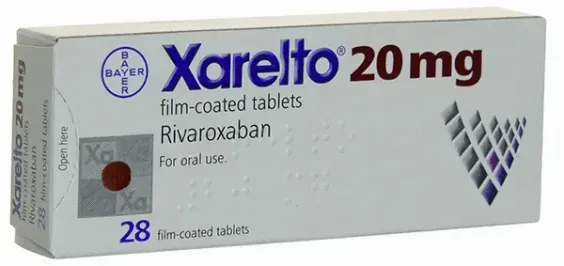
Rivaroxaban blocks one specific clotting factor. Once daily at the higher strengths, and absorption depends on taking it with a meal.
Without prescription, plain packaging. Never stop it on your own.
Atrial fibrillation. The upper heart chambers quiver rather than contract. Blood stagnates in the corners and clots. A fragment travelling to the brain causes a stroke — which is how an irregular pulse becomes a neurological catastrophe.
Deep vein thrombosis. A clot in a leg vein. Part of it breaking loose and reaching the lungs is a pulmonary embolism.
After hip or knee replacement. Immobility plus surgical trauma is a potent combination for clotting, and prevention runs for a defined period afterwards.
None of these give warning. That is exactly the point of continuous treatment.
One factor in the cascade
Clotting works as a chain reaction — each factor activating the next, amplifying at every step until a fibrin mesh forms.
Rivaroxaban blocks factor Xa, which sits at the convergence point of two seperate branches of that chain.
Block there and the amplification stops, without disabling every part of the clotting system. The effect is predictable enough that a fixed dose works without routine blood tests.
Why does it have to be taken with food?
At the higher strengths used for atrial fibrillation and clot treatment, absorption is substantially better with food.
Taken on an empty stomach, a meaningful fraction of the dose simply does not get absorbed. Which means less protection, from a medicine whose entire purpose is protection.
So: with your main meal, same meal each day. Build it into a routine rather than remembering separately.
This is the single most common mistake made with this drug, and nothing about how you feel would ever reveal it.
No INR, no vitamin K rules
If you have been on warfarin, this is the difference.
Warfarin interferes with vitamin K, so every change in diet shifts the effect and regular blood tests are needed to keep it in range.
Rivaroxaban does not touch vitamin K. Fixed dose, predictable effect, no routine clotting tests, and no restrictions on green vegetables.
Kidney function still gets checked periodically, since the kidneys clear part of the dose.
Never stop it on your own
Stopping leaves you unprotected against the exact risk the medicine exists to prevent, and that risk does not pause.
Any planned procedure — surgery, dental extraction, endoscopy, an injection into a joint — gets arranged in advance with whoever is performing it. There is a proper way to time the gap, and guessing is not it.
And because it is taken once daily, a missed dose leaves a longer gap than with twice-daily alternatives. Consistency matters.
Bleeding: what is normal and what is not
Expected and minor: easier bruising, occasional nosebleeds, gums bleeding when brushing, heavier periods, cuts taking longer to stop.
Urgent:
Black or tarry stools
Vomit resembling coffee grounds
Blood in the urine
Severe headache that will not shift
Sudden weakness, confusion or trouble speaking
Large unexplained bruising
Any significant blow to the head, even without symptoms
The head injury point matters most. Bleeding inside the skull can develop quietly over hours.
What raises the risk
Anti-inflammatory painkillers — the most common avoidable factor
Aspirin or other antiplatelet drugs, unless deliberately combined
Some antidepressants
Certain antifungals and HIV medicines, which raise the level
St John's wort, which lowers it and therefore the protection
Heavy alcohol use
Paracetamol is the usual safer option for everyday pain.
Practical habits
Soft toothbrush, electric razor
Carry something identifying you as on an anticoagulant
Tell every dentist and clinician before anything invasive
Reconsider contact sports
Take falls seriously, particularly if you are older
Ordering without prescription: how it works
Once-daily dosing with food is easy to keep up — provided the pack does not run out.
Pick the strength and the pack size, put in a delivery address, confirm. Couple of minutes, any time of day, no queue and no conversation accross a counter.
It goes out in plain packaging. No pharmacy name on the outside, nothing that hints at what is inside. How long delivery takes depends on where the parcel is headed.
On price it comes down to strength and pack size. Larger packs generally work out better per unit, which matters on something taken long term.
Parcels leave on working days, so UK public holidays and weekends push everything back. If it matters to a date, order with a few days to spare rather than none. Nobody can promise a calendar day.