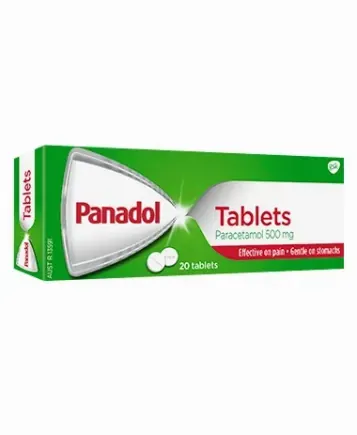
Paracetamol is in every household and treated as harmless. It is well tolerated at the correct dose — and genuinely dangerous above it.
The margin is narrower than its reputation suggests, and overdose causes liver damage that may not announce itself for days.
Without prescription, plain packaging. Count what you are taking.
Why does it suit people who cannot take anti-inflammatories?
Paracetamol is not an anti-inflammatory. It does not act meaningfully on inflammation in tissue.
Which means it does not carry the stomach, kidney and blood pressure risks that go with that class.
So it is the usual choice for anyone with stomach ulcers, kidney problems, asthma triggered by aspirin, on blood thinners, or in pregnancy.
The trade-off: it is less effective where inflammation is the main driver — an inflamed joint, an acute injury with swelling.
The mechanism is still debated
Unusual for something this old and this widely used.
It acts mainly in the central nervous system rather than in peripheral tissue. It inhibits prostaglandin production in the brain and spinal cord, which raises the pain threshold and resets the body's temperature setting downward.
Other pathways are likely involved, including systems the body uses for its own pain modulation.
What is clear is that it works centrally. Which explains both why it helps headache and fever well, and why it does little for a swollen joint.
Why does the total dose matter so much?
This is the section that matters most.
Paracetamol has a narrower margin between the therapeutic dose and the harmful one than its reputation suggests. Exceeding the daily maximum can cause serious liver damage.
And the most common way people do this is not deliberately. It is by accident.
Paracetamol is in cold and flu remedies. In combination painkillers. In some prescription tablets. People take a headache tablet, a cold remedy and something for backache, and exceed the limit without realising there was any limit to exceed.
Check the ingredients of everything you take
Never take two paracetamol-containing products together
Space doses properly — do not take another because the first "did not work"
Never exceed the stated daily maximum
The maximum is lower if you are underweight, drink regularly, are malnourished, or have liver problems.
Overdose is deceptive, and that is the danger
This needs stating clearly because it causes avoidable deaths.
In the first hours after a significant overdose, people often feel fine. Perhaps a little nauseated. No pain, no dramatic symptoms.
Meanwhile liver damage is developing. By the time jaundice, abdominal pain and confusion appear — usually a few days later — the damage may be irreversible.
The treatment is highly effective, but only if given early.
So after any suspected overdose, seek help immediately, even if you feel perfectly well. Especially if you feel perfectly well. Do not wait for symptoms.
Alcohol increases the risk
Regular drinking depletes the liver's capacity to handle the toxic breakdown product paracetamol produces.
Which means doses that would be safe for most people can cause harm in someone who drinks heavily. The daily maximum is lower in that situation.
Not a reason to avoid paracetamol. A reason to be careful about the amount.
Taking it
Space doses at the stated interval, not more often.
With or without food.
Plenty of water.
Do not exceed the daily maximum.
Possible side effects
At the correct dose, few. That is the main argument for it.
Rarely, rash or itching
Very rarely, blood disorders with prolonged use
Liver damage in overdose
Stop and get help for a widespread rash with blistering, or involvement of the mouth and eyes.
Medication-overuse headache
Worth knowing, because it is a trap people fall into with any painkiller.
Taking painkillers too frequenly causes headaches in itself. Those get treated with more painkillers, and the loop closes.
The pattern: a dull headache present most days, worst in the morning.
The safety rule is simple — painkillers a few days a month, not a few days a week. Breaking that cycle usually requires help, because the first days are worse before they are better.
Ordering without prescription: how it works
This belongs in a cupboard before it is needed, not bought during a fever.
Pick the strength and the pack size, put in a delivery address, confirm. Couple of minutes, any time of day, no queue and no conversation across a counter.
It goes out in plain packaging. No pharmacy name on the outside, nothing that hints at what is inside. How long delivery takes depends on where the parcel is headed.
On price it comes down to strength and pack size. Larger packs generally work out better per unit.
Nothing is asked of a UK buyer beyond an address. No prescription to upload, no consultation, nobody ringing back to ask questions you did not invite. You pick the strength, you pick the quantity, that is it.