All proton pump inhibitors reduce stomach acid. The differences between them are mostly about what else they interfere with.
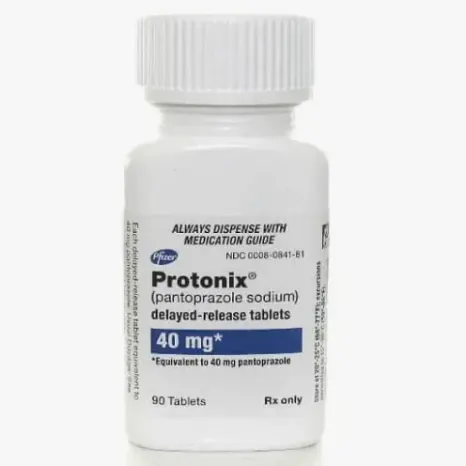
Pantoprazole has the least effect on the liver enzymes that process other drugs, which is often why it gets picked.
Without prescription, plain packaging. Same before-breakfast rule applies.
A reasonable question, since they all block the same pump.
The real differences are in how much they interfere with other medicines, and in how predictably they are metabolised between individuals.
Pantoprazole is the one with the least involvement in the liver enzyme systems that handle other drugs.
Which makes it the usual choice for someone already on several medicines — particulary where an interaction with another tablet would be a real problem.
The pump, and why the effect outlasts the drug
Cells in the stomach lining have a pump that moves acid into the stomach. It is the final step, regardless of what prompted production.
Pantoprazole binds to active pumps and disables them irreversibly.
Restoring acid production requires the cell to manufacture new pumps, which takes a long time. So a drug cleared from the blood within hours produces a day of effect.
This is also why the timing rule exists: only pumps that are currently active can be blocked.
Before breakfast
Half an hour to an hour before the first meal.
Swallow whole — do not crush or chew.
Same time every day.
Allow several days for full effect.
Pumps activate when food arrives. The drug has to be in circulation at that point. Taken with or after breakfast, much of the dose is wasted.
The tablet coating protects it from stomach acid. Crushing it destroys the dose.
Where the interaction advantage matters
Situations where this one tends to be preferred:
Anyone on clopidogrel after a stent
People taking multiple regular medicines
Those on medicines with a narrow margin between effective and too much
Patients on epilepsy medication
People on transplant medicines
It is not interaction-free — nothing is — but it is the one that stays out of the way most.
Stopping it without the rebound
Acid suppression over weeks prompts the body to increase the signals driving acid production. Stop suddenly and those signals hit a stomach that can produce acid again immediately.
The result feels like severe heartburn returning, worse than before. It is rebound, not relapse, and it resolves within a couple of weeks.
Tapering gradually, or stepping down to an H2 blocker, avoids most of it. Worth planning rather than discovering.
Long-term considerations
Stomach acid is not purely a nuisance. It kills swallowed bacteria and assists absorption of several nutrients.
So prolonged suppression carries some trade-offs: reduced B12 and magnesium absorption, a modest increase in certain gut infections, and an association with fractures over many years.
The sensible position is to take it when there is a reason, and to revisit that reason periodically rather than continuing indefinitely by default.
Possible side effects
Headache
Diarrhoea or constipation
Nausea, abdominal pain
Wind
Dizziness
Rash
Persistent diarrhoea, muscle cramps or unexplained weakness during long-term use are worth checking, as they can point to low magnesium.
What else to change
Last meal at least three hours before lying down
Smaller portions
Bed head raised on blocks rather than pillows
Reducing abdominal weight
Less alcohol, coffee, chocolate, mint and fried food
Stopping smoking
Reviewing medicines that cause reflux in the first place
Red flags that need investigating, not treating
Difficulty or pain swallowing
Food sticking on the way down
Unexplained weight loss
Vomiting blood, or material like coffee grounds
Black, tarry stools
Persistent vomiting
New symptoms starting after middle age
Anaemia found on a blood test
Acid suppression can mask those by relieving the discomfort while whatever is behind it continues. That is the main argument against simply taking something indefinitely and never getting looked at.
Ordering without prescription: how it works
Treatment courses run for weeks, so people generaly order the whole course at once.
Pick the strength and the pack size, put in a delivery address, confirm. Couple of minutes, any time of day, no queue and no conversation across a counter.
It goes out in plain packaging. No pharmacy name on the outside, nothing that hints at what is inside. How long delivery takes depends on where the parcel is headed.
On price it comes down to strength and pack size. Larger packs generally work out better per unit.
Delivery goes anywhere in the UK, in plain outer packaging with no logo and no product name on it. How long it takes depends on where it is heading and which service you picked. Prices are in pounds.