Ventolin Inhaler
| Product | Quantity | Per Unit | Price | Buy |
|---|---|---|---|---|
| Ventolin Inhaler - 100mcg | 1 inhaler | £22.00 | £24.44 £22.00 −10% | |
| Ventolin Inhaler - 100mcg | 3 inhaler | £19.33 | £64.44 £58.00 −10% | |
| Ventolin Inhaler - 100mcg | 6 inhaler | £18.00 | £120.00 £108.00 −10% |
 PharmaAccess
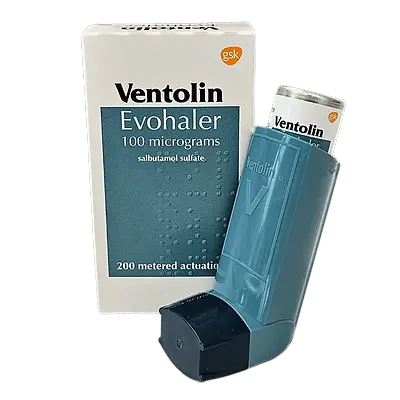
| Product | Quantity | Per Unit | Price | Buy |
|---|---|---|---|---|
| Ventolin Inhaler - 100mcg | 1 inhaler | £22.00 | £24.44 £22.00 −10% | |
| Ventolin Inhaler - 100mcg | 3 inhaler | £19.33 | £64.44 £58.00 −10% | |
| Ventolin Inhaler - 100mcg | 6 inhaler | £18.00 | £120.00 £108.00 −10% |
Around every small airway sits a ring of smooth muscle. In an attack that ring contracts and squeezes the tube shut from the outside.
Salbutamol binds to beta2-receptors on that muscle. Binding triggers a chain inside the cell that makes the muscle relax.
The airway widens within about five minutes, and the effect holds for a few hours.
What it does not do is touch the inflammation underneath. The swelling and the mucus are untouched. It opens a narrowed tube; it does not treat why the tube keeps narrowing.
That single fact explains everything else on this page.
Note the difference from a dry powder device: here the breath should be slow, not forceful. Breathe in too fast with an aerosol and most of the dose hits the back of your throat.
A spacer makes a substantial difference, especially for children and anyone who struggles to coordinate the press and the breath. It is not a sign of poor technique — it genuinely delivers more of the dose where it belongs.
This is the most useful thing on the page, so here it is plainly.
A reliever used occasionally means the underlying treatment is working. A reliever needed several times a week means it is not.
Going through inhalers quickly is not a sign that you have found a good medicine. It is a warning sign, and it is associated with worse outcomes.
Other things pointing the same way: waking at night with symptoms, needing it before any exercise, or finding the effect wears off faster than it used to.
The answer to any of those is reviewing the preventer treatment, not using more reliever.
Very common, usually harmless, and worth expecting rather than being alarmed by.
Beta2-receptors are not only in the airways. Some sit in skeletal muscle and in the heart, which is where the tremor and the palpitations come from.
It is most noticable after several puffs in quick succession, and it settles within an hour or so.
Heavy use can also lower potassium, which matters more if you are also on diuretics.
A blocked mouthpiece delivers nothing while still making the sound of a dose. It is worth checking.
If the reliever is not working, that is the emergency. Do not wait it out.
Warning signs: cannot speak a full sentence, lips or fingertips turning blue, sitting forward braced on the arms, breathing fast and shallow, increasing drowsiness or confusion.
Get help immediately. In a severe attack minutes count, and the quiet chest that follows a wheezing one is worse, not better.
Most people keep more than one — one where they live, one where they work, one in the bag.
Pick the strength and the pack size, put in a delivery address, confirm. Couple of minutes, any time of day, no queue and no conversation accross a counter.
It goes out in plain packaging. No pharmacy name on the outside, nothing that hints at what is inside. How long delivery takes depends on where the parcel is headed.
On price it comes down to strength and pack size. Larger packs generally work out better per unit, which matters on something taken long term.
A parcel locker or a work address works as well as home for UK delivery, provided the details are complete and the name is on the door. The plain packaging is unchanged either way.
Active ingredient: albuterol. Albuterol — MedlinePlus (NIH). Reviewed: 17 September 2026.
No reviews yet. Be the first to leave a review!