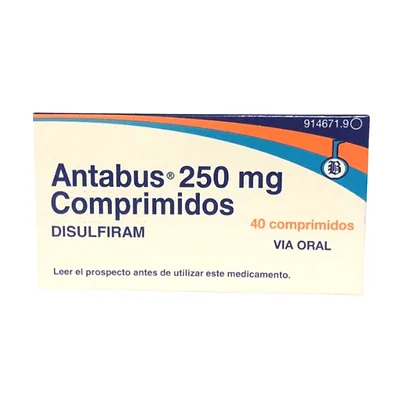
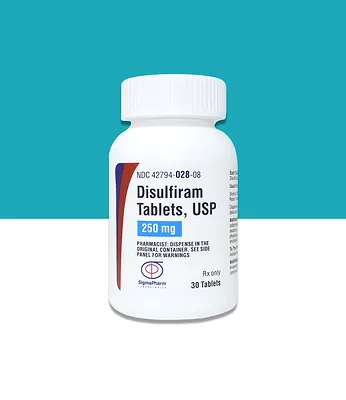
One decision in the morning instead of many in the evening
Deciding not to drink is easy at eight in the morning and hard at eight in the evening, when you are tired and someone has offered.
Disulfiram moves the decision. Take the tablet in the morning and the evening choice has already been made.
Without prescription, plain packaging. Alcohol must be eliminated completely, including places you would not think of.
First it becomes acetaldehyde, a genuinely toxic compound responsible for most of what a hangover feels like. Then an enzyme converts acetaldehyde into something harmless, quickly.
Disulfiram blocks that second enzyme.
Acetaldehyde accumulates instead of being cleared. Even a small amount of alcohol produces a severe and rapid reaction: flushing, pounding heart, violent nausea, vomiting, throbbing headache, a drop in blood pressure.
It is deeply unpleasant, which is the entire point.
What it actually changes psychologically
This is the part worth understanding, because it is not really about the reaction.
Someone trying to stop drinking faces the decision repeatedly, every evening, in exactly the circumstances where resolve is weakest — tired, stressed, in company, with alcohol in front of them.
Taking the tablet in the morning settles that. By the evening, drinking is simply not available as an option, so the argument does not happen.
One decision, made when you are clear-headed, instead of a dozen made when you are not. That shift is the mechanism that matters.
Alcohol hides in more places than you expect
Complete avoidance is not optional, and people get caught out by things they never considered alcohol at all.
Mouthwash and some toothpastes
Cough syrups and herbal tinctures
Hand sanitiser, used heavily
Sauces, desserts and dishes cooked with wine or spirits
Some aftershaves and skin products, absorbed through skin
Low-alcohol and "alcohol-free" beer, which often is not entirely
Vinegar-based dressings in quantity
And the reaction remains possible for well over a week after the last tablet. That surprises people who assume stopping the medicine ends it.
Starting: only after you are completly sober
This is a safety point, not a formality.
The first tablet must not be taken while there is any alcohol in your system. A reaction then would not be a deterrent — it would be dangerous.
A clear interval after the last drink is required. And withdrawal from heavy, prolonged drinking is itself a medical situation requiring supervision: tremor, sweating, hallucinations, seizures and confusion are all possible and some of them are life-threatening.
Detox first, under supervision. Then this.
The tablet alone is not a treatment
Being honest about this matters, because expectations get set wrongly.
Disulfiram creates a barrier. It does not change why someone drinks, and it teaches nothing about coping without alcohol.
Which means it works as part of something larger: counselling, a support group, changes to environment and routine. On its own, the barrier eventually just gets removed by stopping the tablet.
Supervised dosing — someone else present when it is taken — substantialy improves how well it works, for exactly this reason.
Possible side effects, apart from the reaction
A metallic or garlic-like taste
Drowsiness, especially early on
Headache
Fatigue
Skin rash
Reduced appetite
Liver function needs monitoring. Report yellowing of the skin or eyes, dark urine, persistent nausea, or pain under the right ribs.
Occasionally it causes nerve symptoms with longer use — numbness or tingling in the hands or feet. That needs reporting.
When the reaction becomes an emergency
Most reactions are severe but self-limiting. Some are not.
Chest pain, severe breathlessness, fainting, confusion or an irregular heartbeat during a reaction need emergency help immediately.
Ordering without prescription: how it works
This works through daily consistency, so a lapse in supply is a lapse in the barrier itself.
Pick the strength and the pack size, put in a delivery address, confirm. Couple of minutes, any time of day, no queue and no conversation across a counter.
It goes out in plain packaging. No pharmacy name on the outside, nothing that hints at what is inside. How long delivery takes depends on where the parcel is headed.
On price it comes down to strength and pack size. Larger packs generally work out better per unit.
Prices sit below a UK high street counter for an unglamorous reason: no rent in a good location, no counter staff, no window display. Most of the range is generic as well. That saving goes to you.