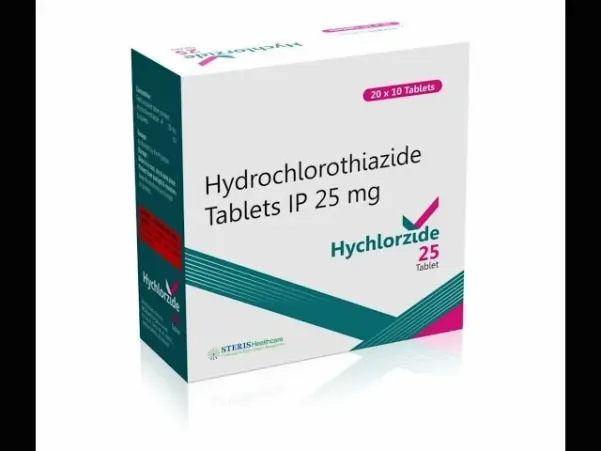
Not every diuretic is about shifting litres of fluid. A thiazide works quietly in the background on blood pressure.
Hydrochlorothiazide reduces salt reabsorption modestly, and over weeks it also relaxes the vessel walls themselves.
Without prescription, plain packaging. Morning dose, and mind the sun.
People hear "diuretic" and picture spending the morning in the bathroom. A thiazide is a different animal.
Hydrochlorothiazide blocks a salt transporter in a later part of the kidney tubule, one handling a much smaller share of reabsorption than the segment strong diuretics target.
So the increase in urine is modest. Noticeable in the first week or two, then it settles considerably.
And here is the interesting part: the blood pressure effect persists and even grows after the diuretic effect has largely faded. Over weeks, these drugs relax the smooth muscle of the vessel walls themselves, and that is where most of the long-term benefit comes from.
Why it is so often combined
Thiazides pair unusually well with other blood pressure medicines, especially ACE inhibitors and sartans.
The reason is mechanical. A thiazide activates the hormone system that raises blood pressure, which partially offsets its own effect. An ACE inhibitor or sartan blocks exactly that system.
Each one closes the other's escape route. The combined effect is more than the sum of the parts, which is why so many blood pressure tablets contain both in one pill.
Morning, consistently
One tablet in the morning.
With or without food.
Not in the evening, unless you want interrupted sleep.
Give it several weeks for the full blood pressure effect.
The urinary effect eases after the first couple of weeks. Plenty of people stop before getting past that, which is a shame since the main benefit arrives later.
Potassium, again
Thiazides cause potassium loss. Less dramatically than strong diuretics, but over months it adds up.
Low potassium shows up as cramps, weakness, fatigue, palpitations and constipation. It is easily checked with a blood test and easily corrected.
Sodium can drop too, and low sodium is particulary common in older people on thiazides. Confusion, unsteadiness and unusual drowsiness are the signs, and they get wrongly put down to age.
Blood tests after starting and periodically thereafter are part of the treatment, not an optional extra.
Sun sensitivity — genuinely worth knowing
This one surprises people and it is not a minor footnote.
Thiazides make the skin considerably more reactive to sunlight. You can burn faster than expected, and some people develop a rash on sun-exposed areas.
What that means in practice: proper sun protection, covering up in strong sun, and being careful on holiday. People who have taken it for years without trouble sometimes get caught out in a stronger climate.
Gout and blood sugar
Two metabolic effects worth being aware of.
Thiazides reduce uric acid excretion, so levels rise and an attack of gout can be triggered in someone predisposed. A suddenly hot, swollen, intensely painful joint while on this is not a coincidence.
They can also nudge blood sugar upward slightly. Relevant if you have diabetes or are near the threshold, and worth monitoring rather than ignoring.
Neither is a reason to avoid the drug. Both are reasons to mention it if either problem appears.
Possible side effects
More frequent urination, mainly early on
Dizziness on standing
Low potassium or sodium
Muscle cramps
Raised uric acid
Sun sensitivity
Slightly raised blood sugar and cholesterol
Erectile difficulties in some men
That last one is underreported because people do not connect it to a blood pressure tablet and do not raise it. If it appears after starting, say so — alternatives exist.
Salt still matters
A drug that works by removing salt is directly undermined by a high-salt diet.
The main sources are bread, processed meat, cheese, ready meals and takeaways rather than the salt cellar. Cutting those improves the result measurably.
One caution: salt substitutes are usualy potassium chloride, and combined with an ACE inhibitor or sartan that can push potassium too high. Reducing salt is better than replacing it.
Ordering without prescription: how it works
A daily tablet taken over years only works if the supply never lapses.
Pick the strength and the pack size, put in a delivery address, confirm. Couple of minutes, any time of day, no queue and no conversation across a counter.
It goes out in plain packaging. No pharmacy name on the outside, nothing that hints at what is inside. How long delivery takes depends on where the parcel is headed.
On price it comes down to strength and pack size. Larger packs generally work out better per unit, which matters on something taken long term.
What you pay follows pack size and strength, shown in pounds next to the quantity options. Bigger packs come out lower per unit. A generic stays below the branded version with the same ingredient inside.