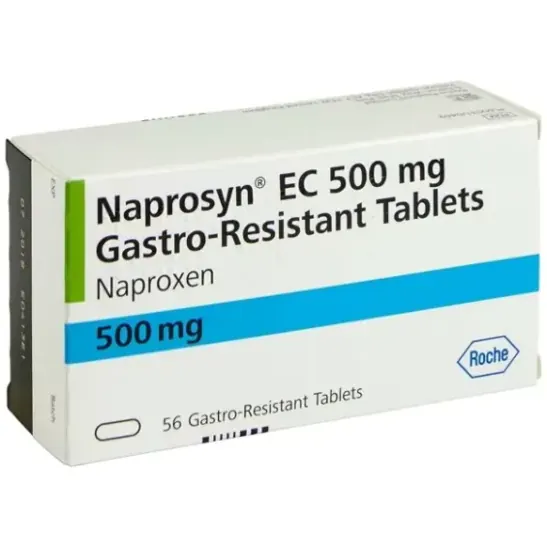
Pain that keeps coming back every four hours means a day built around tablet times.
Naproxen lasts longer than most of its relatives, so twice-daily dosing covers the day — which matters for arthritis and for period pain.
Without prescription, plain packaging. Always with food.
Most anti-inflammatory painkillers need taking three or four times daily. Naproxen lasts long enough for twice.
That sounds minor. It is not, for two situations in particular.
Arthritis, where pain is continuous rather than episodic. Steady coverage works better than peaks and troughs, and morning stiffness is less likely to break through.
Period pain, where you want to get ahead of it and stay there for a day or two without clock-watching.
What it treats
Osteoarthritis and rheumatoid arthritis
Ankylosing spondylitis
Acute gout
Period pain
Muscle and joint injuries
Tendon inflammation
Headache and dental pain
How it works
When tissue is damaged, the body produces prostaglandins. They amplify inflammation and sensitise nerve endings, which is why an injury hurts more than the damage itself would suggest.
Naproxen blocks the enzyme that produces them.
Less pain, less swelling, and less fever. Three effects from one mechanism.
Period pain: timing beats dose
Genuinely useful and frequently got wrong.
Period pain is caused by prostaglandins making the uterus contract strongly. These drugs block prostaglandin production — which means they work far better before a large amount has been produced.
Starting at the first sign, or even a day before if your cycle is predictable, works considerably better than waiting until the pain is established.
Once the prostaglandins are already there, you are waiting for them to clear. Prevention is a different proposition from rescue.
The stomach risk is not a footnote
Anti-inflammatory painkillers block an enzyme called COX. That stops the production of substances driving pain and inflammation, which is the point.
The same enzyme also produces the prostaglandins that protect your stomach lining — maintaining mucus, stimulating protective bicarbonate, keeping blood flow to the lining healthy.
Block the enzyme and you lose that protection along with the pain.
What makes it dangerous is that it does not have to hurt first. A bleeding ulcer can be the first sign, with no preceding indigestion at all.
Urgent signs: black tarry stools, vomit resembling coffee grounds, sudden severe abdominal pain, unexplained pallor, weakness or breathlessness.
For longer courses, a stomach-protecting medicine is often added deliberately. Risk is higher with increasing age, a previous ulcer, steroids, or blood thinners.
Taking it
Twice daily, roughly twelve hours apart.
Always with food or a glass of milk.
Swallow whole with plenty of water.
Do not lie down immediately afterwards.
Shortest effective course.
Taking it with food is not optional advice. It noticeably reduces the stomach effects, and this is a medicine where those effects matter.
Kidneys, blood pressure and other medicines
Prostaglandins also help maintain blood flow through the kidneys. Blocking them reduces that, which matters in anyone with existing kidney problems or dehydration.
These drugs also raise blood pressure slighly and blunt the effect of blood pressure medicines.
The combination that causes real trouble: an anti-inflammatory plus an ACE inhibitor or sartan plus a diuretic. All three together is a well-recognised cause of kidney injury.
Also relevant: blood thinners, lithium, methotrexate, and other anti-inflammatories — never two at once.
Who should avoid it
Active or previous stomach ulcer
Significant kidney disease
Severe heart failure
Aspirin-sensitive asthma
Taking blood thinners
Later pregnancy
Aspirin-sensitive asthma is worth knowing about: in a minority of people with asthma, these drugs trigger a severe attack. If aspirin has ever caused wheezing, this class is out.
Possible side effects
Indigestion, stomach pain
Nausea
Heartburn
Headache, dizziness
Fluid retention
Raised blood pressure
Shortest course that works
These are effective drugs and they are taken for far longer than they should be.
The risks — stomach, kidney, cardiovascular — accumulate with duration and dose. For a short course in a healthy person they are small. Over months they are not.
If you need daily anti-inflammatory treatment for weeks on end, the question worth asking is whether something else should be managing the underlying condition instead.
Ordering without prescription: how it works
Keeping some in the cupboard is more practical than hunting for an open pharmacy on the first bad day.
Pick the strength and the pack size, put in a delivery address, confirm. Couple of minutes, any time of day, no queue and no conversation across a counter.
It goes out in plain packaging. No pharmacy name on the outside, nothing that hints at what is inside. How long delivery takes depends on where the parcel is headed.
On price it comes down to strength and pack size. Larger packs generally work out better per unit.
A parcel locker or a work address works as well as home for UK delivery, provided the details are complete and the name is on the door. The plain packaging is unchanged either way.