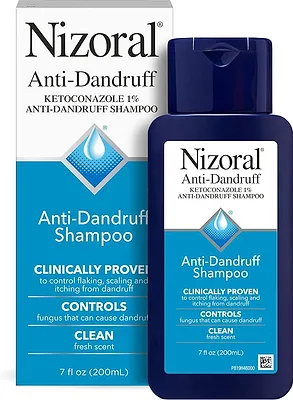
A scalp that itches constantly, with white flakes landing on everything dark you own. Ordinary shampoos rarely touch it.
The usual cause is an overgrowth of yeast, and that needs a medicated shampoo rather than a cosmetic one.
Without prescription, plain packaging. Leaving it on for a few minutes is the whole point.
Most products on the shelf loosen flakes and wash them away. They do nothing about why the flakes are forming.
Persistent dandruff is rarely caused by dry scalp, whatever the advertising implies. It is usualy driven by an overgrowth of a yeast called Malassezia.
That yeast is part of normal skin flora and lives on everybody. When it multiplies excessively, the result is inflammation, itching and heavy flaking.
Which calls for a medicated shampoo, not a cosmetic one.
What it is used for
Persistent dandruff
Seborrhoeic dermatitis — red, greasily scaling patches on the scalp, eyebrows, the sides of the nose and along the hairline
Pityriasis versicolor, the patchy discoloured areas on back and chest
For seborrhoeic dermatitis it can be used off the scalp too, on the face or chest, applied like a wash.
How the yeast is suppressed
Straightforward cell biology.
Fungi need a substance called ergosterol to keep their cell walls stable, much as human cells depend on cholesterol.
Ketoconazole blocks the enzyme that makes it. Without that building block the wall becomes unstable and permeable, and the cell dies.
Reduce the yeast population and the inflammation subsides — and with it the itching and flaking.
Contact time is the entire mechanism
This is where most people lose the benefit, and it takes no extra effort to fix.
Wet the hair and work the shampoo into the scalp, not just the hair.
Massage until it lathers.
Leave it on for several minutes. Do not rinse straight away.
Rinse thoroughly with lukewarm water.
Two or three times a week.
Washing it out like an ordinary shampoo gives the active ingredient no time to work. Contact time is the whole point of the product.
Practical approach: apply it, carry on with your shower, rinse at the end. Then you will not cut it short.
Do not stop completly once it clears
Seborrhoeic dermatitis is a chronic tendency, not a one-off infection. It does not go away permanently, but it controls well.
So after the acute phase people usually move to maintenance use — perhaps once a week instead of several times.
Stop entirely and the dandruff generally returns within weeks. That is the nature of the condition rather than a failure of treatment.
A mild ordinary shampoo can be used between medicated washes.
What makes it worse
Stress — unusually clearly with this condition
Cold, dry weather and indoor heating
An oily scalp
Washing too often with harsh products
Alcohol
A weakened immune system
The stress link surprises people, but flare-ups during difficult periods are one of the most consistently reported features of this condition.
Possible side effects
Dryness or irritation of the scalp
Itching, mainly at the start
Changed hair texture, sometimes drier
Rarely, increased hair shedding
Occasional colour change in dyed or bleached hair
That last point matters if your hair is coloured. Test on a hidden strand if unsure.
Dryness can be offset with conditioner on the lengths — kept off the scalp.
When it is something else
If several weeks of correct use change nothing, the diagnosis may be wrong.
Scalp psoriasis looks similar but has a different cause and needs different treatment. Contact dermatitis from hair products is another possibility.
Also worth showing: weeping areas, open sores on the scalp, heavy hair loss, or bald patches with redness.
Ordering without prescription: how it works
Keeping it under control long term means regular use, which is why people buy it on a schedule.
Pick the strength and the pack size, put in a delivery address, confirm. Couple of minutes, any time of day, no queue and no conversation across a counter.
It goes out in plain packaging. No pharmacy name on the outside, nothing that hints at what is inside. How long delivery takes depends on where the parcel is headed.
On price it comes down to strength and pack size. Larger packs generally work out better per unit.
Prices sit below a UK high street counter for an unglamorous reason: no rent in a good location, no counter staff, no window display. Most of the range is generic as well. That saving goes to you.