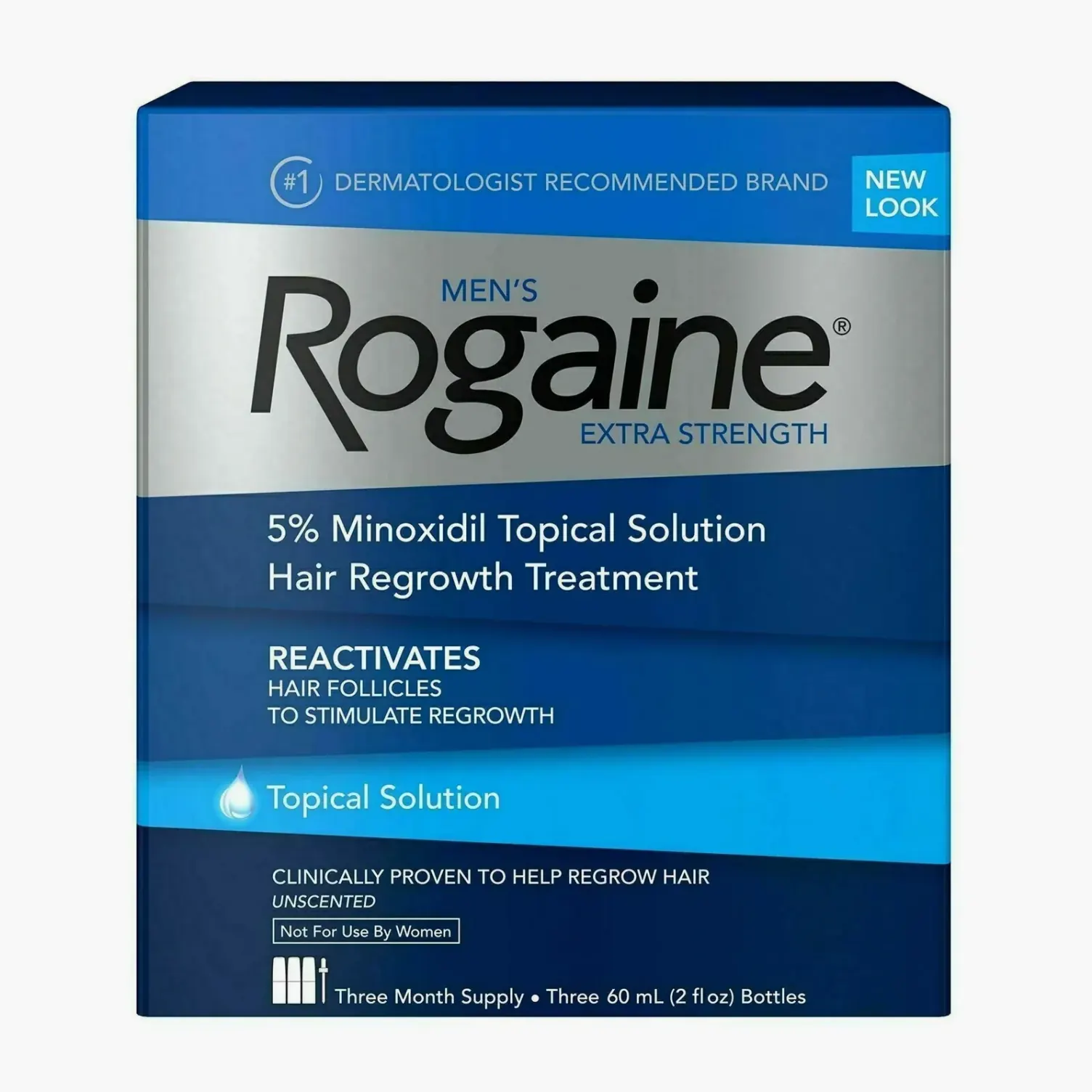
First it is more hair on the brush. Then thinning you can no longer arrange around. And the mirror reminds you daily.
Minoxidil works on follicles that are still alive, extending their growing phase. It does nothing for ones that have closed.
Without prescription, plain packaging. Early shedding is normal, and stopping reverses the gains.
In the most common pattern of hair loss, the problem is sensitivity to a hormone.
Testosterone is converted in the skin into a more potent form. Follicles that are genetically sensitive to it respond by shrinking.
Each cycle, the growing phase gets shorter. The hair produced is finer, shorter and lighter, untill it is barely more than fuzz. Eventually the follicle stops producing anything.
Which sets the timescale. A follicle that has shrunk can still be stimulated. One that has shut down entirely cannot.
That is why these treatments work far better on thinning areas than on skin that is already bare, and why starting earlier gets better results.
How minoxidil helps
Honest answer: the mechanism is not fully pinned down, which is unusual for a treatment this widely used.
It was originally a blood pressure drug, and increased hair growth turned up as an unexpected side effect. The topical version came afterwards.
What is reasonably established: it widens small blood vessels around the follicle, improving the local supply. It opens particular potassium channels in follicle cells. And it lengthens the growing phase of the hair cycle while shortening the resting phase.
More follicles actively growing at any given time, each for longer. That is the visible result.
The shedding phase will alarm you
Know about this in advance, because otherwise you will stop at exactly the wrong moment.
In the first weeks, hair fall often increases noticeably. It looks like the treatment is making things worse.
The opposite is happening. Follicles are being pushed out of the resting phase into a new growth phase, and the new hair physically displaces the old one. What falls out was already finished.
It typically lasts a few weeks and then settles. Visible improvement generally takes several months after that.
Photograph your scalp at the start, same lighting, same angle. Change this slow is invisible in a mirror and obvious in photographs.
What happens if you stop?
The thing to be honest with yourself about before starting.
Minoxidil does not cure anything. It holds the process back for as long as it is being applied.
Stop, and the follicles resume their programme. Within a few months the gains are generally lost, and sometimes the loss catches up quickly.
So the real question is not "shall I try this for six months" but "am I prepared to do this indefinitely".
Applying it
On a dry scalp, not damp hair.
Apply to the skin, not the hair itself.
Spread it across the thinning area and rub it in lightly.
Let it dry fully before anything else touches it.
Wash your hands afterwards.
Twice daily, consistently.
Scalp, not hair. Putting it on the strands achieves nothing — the follicle is under the skin.
Let it dry before bed, or it transfers to the pillow and to wherever your face touches. That is how unwanted facial hair growth happens.
Possible side effects
Scalp irritation, itching or dryness
Flaking
Unwanted hair growth where the product has transferred
Increased shedding at the start
Rarely, dizziness or palpitations
Some irritation comes from the alcohol-based carrier rather than the active ingredient, and a foam formulation is often better tolerated for that reason.
For women, the picture is different
Women rarely get a receding hairline. The pattern is diffuse thinning, most obvious along the parting.
And the causes are more varied: iron deficiency, thyroid problems, the period after childbirth, menopause, a change in contraception, severe stress, or restrictive dieting.
Which means a blood test first is genuinely worthwhile. If iron is low, correcting that may do more than any topical treatment.
Other causes worth excluding
Iron or vitamin D deficiency
Thyroid problems in either direction
Recent serious illness, surgery or high fever
Certain medications
Scalp conditions
Very restrictive diets
Years of tightly pulled hairstyles
Sudden heavy shedding, round bald patches, or a red and scaly scalp point to something other than the common pattern and need looking at properly.
Ordering without prescription: how it works
This is a treatment measured in years rather than months, so people tend to buy in quantity.
Pick the strength and the pack size, put in a delivery address, confirm. Couple of minutes, any time of day, no queue and no conversation across a counter.
It goes out in plain packaging. No pharmacy name on the outside, nothing that hints at what is inside. How long delivery takes depends on where the parcel is headed.
On price it comes down to strength and pack size. Larger packs generally work out better per unit.
Parcels leave on working days, so UK public holidays and weekends push everything back. If it matters to a date, order with a few days to spare rather than none. Nobody can promise a calendar day.