Some bacteria carry an enzyme that destroys penicillin before it can do anything. Against those, amoxicillin alone fails.
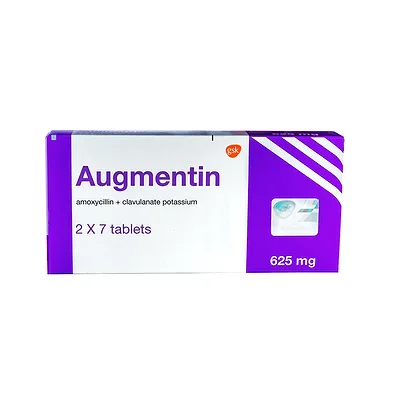
Augmentin pairs it with a second compound that disables that enzyme, so the antibiotic reaches its target intact.
Without prescription, plain packaging. Take it with food — it is harder on the stomach.
It helps to know what you are actually taking, because the second ingredient is not an antibiotic at all.
Amoxicillin is the antibiotic. It blocks the enzymes bacteria use to cross-link their cell wall, so the wall fails and the cell ruptures.
Clavulanic acid has almost no antibacterial activity of its own. Its job is to act as a decoy.
Resistant bacteria produce an enzyme called beta-lactamase that cuts the amoxicillin molecule open. Clavulanic acid looks similar enough to attract that enzyme, binds it permanently and takes it out of action.
The enzyme is occupied destroying the decoy. The amoxicillin sails past and does its work.
When this combination is the right call
Sinus or chest infections that did not clear on plain penicillin
Middle ear infections that keep returning
Bites, human or animal — the mouth flora involved is exactly what this covers
Skin and soft tissue infections
Some urinary and abdominal infections
Dental abscesses
Bites are the classic example. The mix of organisms from a mouth is awkward, and this combination covers most of it in one go.
Why does it upset stomachs more?
Straightforward: the clavulanic acid is the culprit.
Diarrhoea is noticeably more common with Augmentin than with plain amoxicillin, and it is the clavulanate component driving most of it.
Take it at the start of a meal. Not after, not between. That one change makes a real difference to how the course goes.
Plain food, enough fluids, and a probiotic a few hours apart from the dose all help.
Finish the course, even when you feel fine
This is the single most important line on the page.
After two or three days the fever usualy breaks and you feel more or less human again. The temptation to stop is obvious.
But feeling better only means the bacterial numbers have dropped far enough for your immune system to cope. Some are still alive — and they are the toughest ones, the ones that held out longest.
Stop there and you leave exactly those behind. The infection comes back, harder to treat than the first time. That is how resistance builds, one shortened course at a time.
Take the full course. Even if you have felt well for a week.
The liver point
Worth knowing because it is specific to this combination rather than to penicillins generally.
Occasionally it causes liver irritation. More often in older people and on longer courses, and the signs can appear days or even weeks after the course has finished.
Watch for yellowing of the skin or eyes, dark urine, pale stools, persistent nausea, or pain under the right ribs. Stop and get it checked.
Uncommon, and it generally settles. But it is worth being able to recognise.
Allergy
If you have had a genuine penicillin allergy, this is out — the amoxicillin component is a penicillin.
A true reaction means hives, widespread rash, swelling of the face or tongue, wheezing or breathing difficulty. Stop and get help at once.
An upset stomach is not an allergy. Those two get confused constantly, and the confusion closes off a useful antibiotic for no good reason.
Still useless against viruses
A stronger antibiotic is still an antibiotic. Colds and flu are viral and this does nothing for them.
Reaching for the heavier option "just in case" is how resistance spreads fastest. It should be used where it is needed, not as an upgrade by default.
Possible side effects
Diarrhoea, the most common by some distance
Nausea and stomach pain
Thrush
Rash
Headache
Rarely, liver irritation
Severe, watery or bloody diarrhoea, especially with fever, needs reporting rather than riding out.
Ordering without prescription: how it works
A full course in one order avoids the gap that undoes the whole thing.
Pick the strength and the pack size, put in a delivery address, confirm. Couple of minutes, any time of day, no queue and no conversation across a counter.
It goes out in plain packaging. No pharmacy name on the outside, nothing that hints at what is inside. How long delivery takes depends on where the parcel is headed.
On price it comes down to strength and pack size. Larger packs generally work out better per unit.
The outside of the parcel gives nothing away, wherever in the UK it is going. No pharmacy branding, no product name, nothing that suggests medication. For most customers that is the whole reason for ordering online.