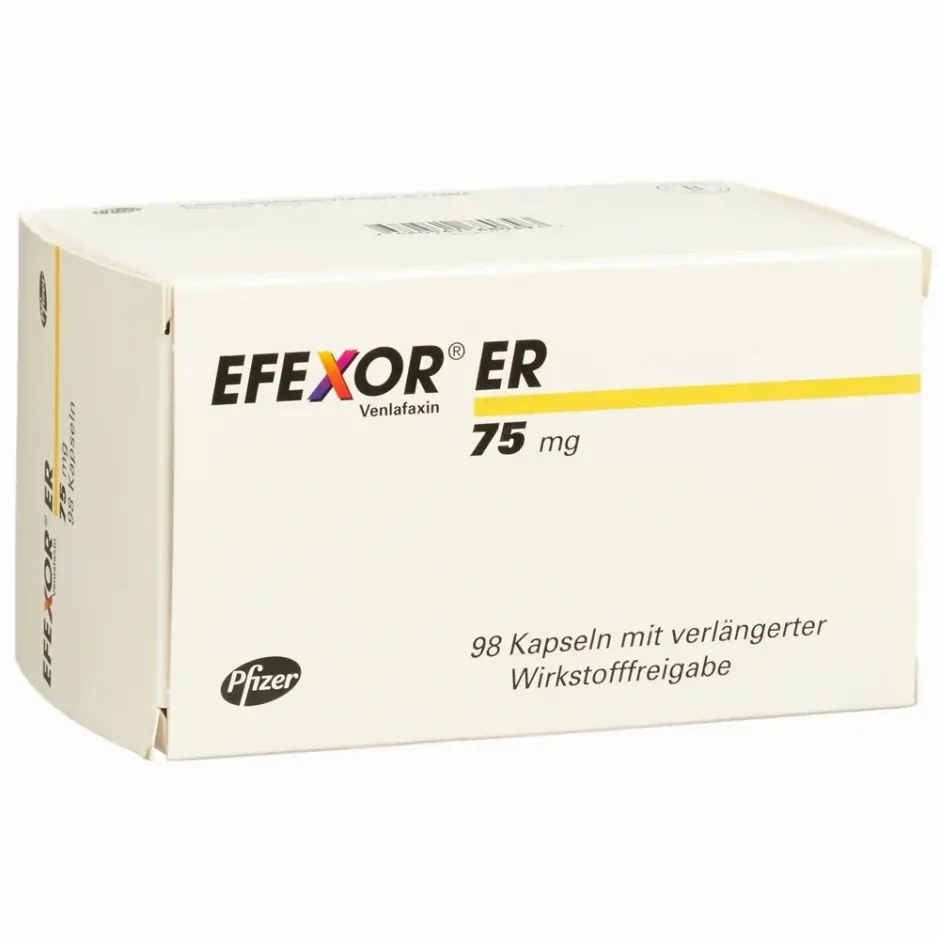
Most medicines do the same thing more strongly as the dose rises. This one does something qualitatively different.
At lower doses venlafaxine acts mainly on serotonin. Higher up, noradrenaline joins in — which changes both the effect and the side effects.
Without prescription, plain packaging. This one needs a very slow taper.
This is the thing that makes venlafaxine distinctive, and it explains a lot about how it is used.
At lower doses it blocks serotonin reuptake almost exclusively. Functionally it behaves like an SSRI.
At higher doses it also blocks noradrenaline reuptake. That adds a different dimension — more effect on drive and energy, and sometimes better results in depression that has not responded to serotonin alone.
At higher still, a small amount of dopamine effect appears.
So it is effectively a different medicine at different points on the scale. Which is why increasing the dose can change not just the intensity but the character of what it does.
What it is used for
Depression, including cases that have not responded to an SSRI
Generalised anxiety
Social anxiety
Panic disorder
Its use in treatment-resistant depression comes directly from the dual action. Adding noradrenaline gives another lever when serotonin alone has not been enough.
Blood pressure, specifically at higher doses
Directly tied to the mechanism, and the main thing to monitor.
Noradrenaline raises blood pressure. So as the dose climbs into the range where noradrenaline is involved, blood pressure can rise with it.
It needs checking before starting and at every dose increase. In someone already hypertensive, that is not optional.
Heart rate can increase too.
Taking it
Once daily with the extended-release form, usually with food.
Swallow whole — do not crush or chew the extended-release capsule.
Same time each day.
The immediate-release form is divided accross the day instead.
Crushing an extended-release capsule releases the whole dose at once, which is both less effective and more likely to cause side effects.
Several weeks before you can judge it
This is the single biggest reason people stop too early.
The level in your blood changes within hours. The effect takes weeks, because what actually helps is a slow rebalancing of the networks involved — not the concentration itself.
And the first days often bring only side effects: nausea, restlessness, worse sleep, no benefit whatsoever. It is a bad trade on day three and a reasonable one on week six.
Drive usually returns before mood does. That is a period needing particular attention, because the capacity to act arrives while the thinking is still dark.
Judge it after several weeks. And when it works, it continues well beyond the point symptoms lift — stopping as soon as you feel better is the most common cause of relapse.
The taper on this one is notoriously difficult
Venlafaxine has the worst reputation in this family for discontinuation, and that reputation is earned.
It has a short duration of action, which means the level falls quickly between doses. Miss one and symptoms can start the same day.
Stopping abruptly produces dizziness, electric-shock sensations, nausea, sweating, irritability, flu-like aching, vivid dreams, and in some people a genuinely miserable couple of weeks.
The taper has to be slow — weeks to months, in small steps, sometimes with a switch to a longer-acting medicine partway down.
Which means two practical things: do not miss doses, and do not let the supply run out.
Interactions to check
Other serotonin-acting medicines, which risk a dangerous excess
Tramadol and certain other painkillers
Triptans for migraine
St John's wort, including as a herbal product
Anti-inflammatory painkillers and blood thinners — bleeding risk rises
Alcohol
Signs of serotonin excess: agitation, confusion, muscle twitching, fever, racing heart, diarrhoea. That is urgent.
St John's wort gets missed constantly because it is sold as a supplement rather than a drug. It interacts seriously, including with contraception.
Possible side effects
Nausea, most common at the start
Dry mouth
Sweating, sometimes marked
Insomnia
Dizziness
Constipation
Sexual difficulties
Raised blood pressure and heart rate
Reduced appetite
Sweating is more prominent with this one than most and surprises people. It often eases but not always.
Bipolar disorder
Antidepressants can trigger a manic episode in someone with bipolar disorder, and this applies to the whole class.
If there is any history of elevated mood, reduced need for sleep with high energy, or impulsive episodes, that needs establishing before starting rather than discovering afterwards.
When to get help immediately
Thoughts of ending your life are an emergency. Not a sign of weakness, and not something to sit with alone.
Contact someone who can help without delay — a crisis line, an emergency service, a person you trust. That applies especially in the early weeks of treatment or after a dose change, when such thoughts can surface.
Ordering without prescription: how it works
The short duration of action makes gaps in supply unusually unpleasant, so people stay well ahead.
Pick the strength and the pack size, put in a delivery address, confirm. Couple of minutes, any time of day, no queue and no conversation across a counter.
It goes out in plain packaging. No pharmacy name on the outside, nothing that hints at what is inside. How long delivery takes depends on where the parcel is headed.
On price it comes down to strength and pack size. Larger packs generally work out better per unit, which matters on something taken long term.
Delivery goes anywhere in the UK, in plain outer packaging with no logo and no product name on it. How long it takes depends on where it is heading and which service you picked. Prices are in pounds.